Turn Your Favorite Loose Gemstones Into Beautiful Wire-Wrapped Jewelry
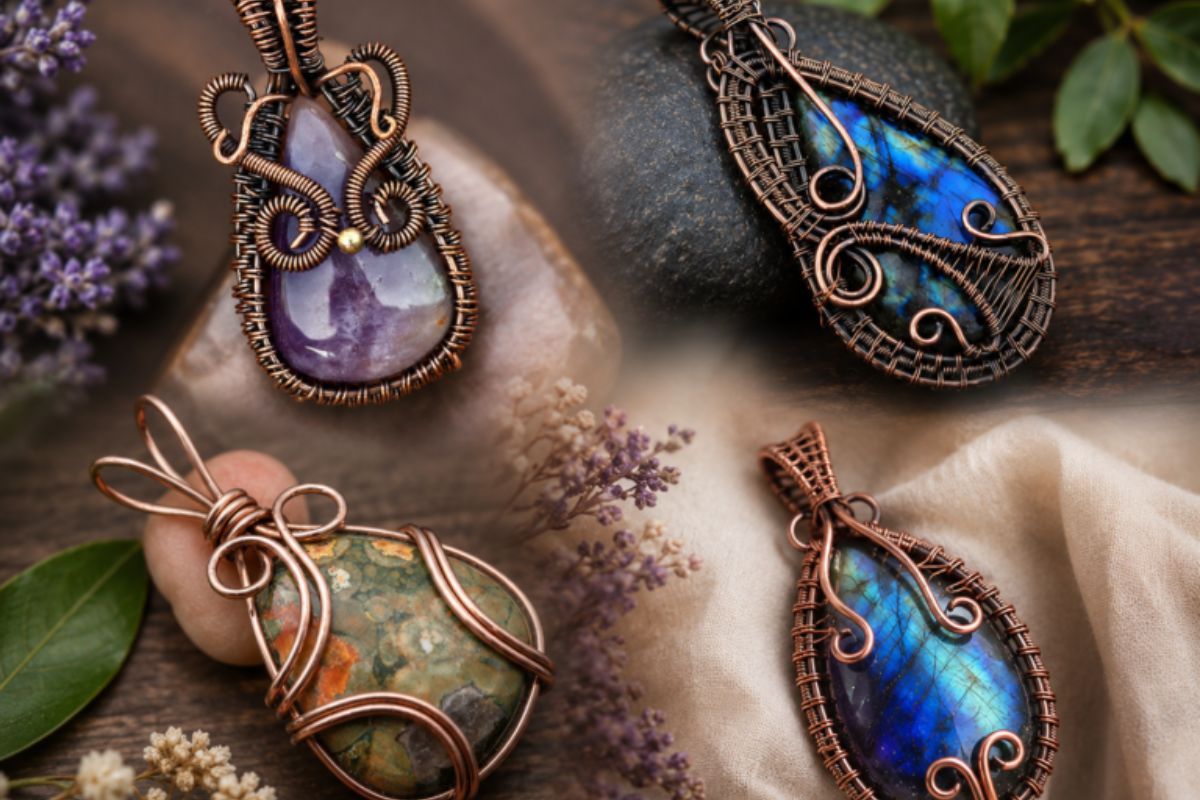
Buying a loose gem is easy, but turning it into something you can actually wear is where the real challenge begins. But the good news is that you don’t need years of training or any hard tools to do it. Wire wrapping is one of the most accessible ways through which you can easily transform your loose gemstone into a wearable piece.
This technique is beginner-friendly because it does not require torches, soldering, or any complex equipment. From choosing materials to mastering essential techniques to converting your loose stone into a stunning piece, this guide covers each topic that you should know when making any kind of wire-wrapped gemstone jewelry. Let’s get started by understanding:
How to Choose the Right Loose Gemstone for Wire Wrapping
Not every loose gem is best for your wire-wrapped jewelry design. You need to choose the right gemstone with a perfect cut, shape, and hardness so that it can easily be wrapped and secured without breaking.
- Cabochons vs. Faceted Gems: For this technique, cabochons are the easiest to wrap. Because these stones have a smooth, rounded top and a flat bottom that makes it easy to fit them against a wire frame without any fear of slipping out. Faceted gems, on the other side, can also be wrapped with careful positioning. Their sharp edges and small girdle make them hard to grip with wire.
- Flat-Back or Natural Edges Gems: Stones with a flat back or clear grooves sit well against this setting. Stones with uneven or unique sides require precise, tight wire cage designs to hold the rough shapes safely.
- Gem Size and Shape Impact: Consider larger stones of 20 mm to 40mm because they provide ample space to maneuver wire and build confidence. Symmetrical shapes are usually simple to wrap and are easy to handle because wire follows the curve easily.
- Durability and Hardness: These are major factors you need to check before wire wrapping any stone. Delicate stones (under 5) can get scratched easily. This is why consider choosing harder gems (above 6.5) that withstand structural wire pressure and can be worn daily.
If you are a beginner, Amethyst, agate, Jasper, labradorite, turquoise, and moonstone are the best loose gemstones for jewelry making.
How to Pick the Right Wire for Your Gemstone
| Wire Materials | Type | Defining Quality |
| Copper | Cheap and soft, great for beginners and practice. | |
| Sterling Silver | This looks bright and shiny and holds the shape well. | |
| Gold-Filled Wire | This has a real gold layer over the core metal and costs less. | |
| Brass or Bronze | This displays earthy color and costs less. | |
| Wire Gauge (Thickness) | 16 to 20 gauge | These are thick and rigid, ideal for heavy stones and pieces. |
| 21 to 24 gauge | Great for general wire wrapping, secure bails, and medium pendants. | |
| 26 to 30 gauge | Very thin and flexible, best for fine weaving, delicate coiling, and binding base wires together. | |
| Wire Hardness | Soft Wire | This bends very easily with your fingers and is best for fine details and tight loops. |
| Half-Hard Wire | This is stiff and holds its shape well. Usually used for structural frames that must not bend. | |
| Matching Wire to Gem Size | Small stones under 10g | Should use a 20 to 22 gauge base wire with 24 to 26 gauge weaving wire. |
| Medium stones with 10g to 30g | Should use 18 to 20 gauge base wire. | |
| Large stones with over 30g | Should use a heavy 16 to 18 gauge base wire to make the frame stay rigid. |
Some Essential Tools for Beginners
- Flush Cutters are used to trim wire ends flat to avoid sharp edges.
- Round Nose Pliers are used to bend wires into a smooth, round loops and curves.
- Flat Nose Pliers are used to make sharp and precise right-angle bends and flatten wire.
- Nylon Jaw Pliers are used to straighten or bend wire without leaving ugly scratches or marks.
- Ring Mandrel is used to shape and size the wire rings accurately.
- Chain Nose Pliers are smooth, narrow jaws that grip tight wire spaces, close loops, and hold the wire steady.
Top 5 Wire Wrapping Techniques for Beginners
- The Basic Cage Wrap: This uses a simple cross-wire structure that helps hold the stone securely by crossing wires over the front and back.
- Traditional Cabochon Framing: This uses a secure base wire frame shaped to the gem’s contour to lock it in place with tighter weaving or wrapping around the girdle.
- Simple Bail Wrap: This is a method used for shaping and binding the excess top wires into a loop or channel above the stone.
- Wrapping a Point: It is a specialized approach that requires tapering and twisting the wire tightly around the pointed tip of a stone to secure the end.
- Decorative Accent Techniques: Finishing moves like spirals and rosettes are used to hide the sharp wire ends and to add artistic flair to the design.
Conclusion
Wire wrapping is a craft that anyone can learn by practicing without needing any expensive machinery. You can just start simply by selecting a single loose gem that you want to wear, a flexible base wire, and securing your gem tightly in your own decorative style. So, are you ready to kick-start your next jewelry project? Shop natural gemstones for jewelry making now and turn your favorite stones into wearable art.

Leave a Reply
You must be logged in to post a comment.