D’Art Reveals the Power of Store Deployment in Retail Sector
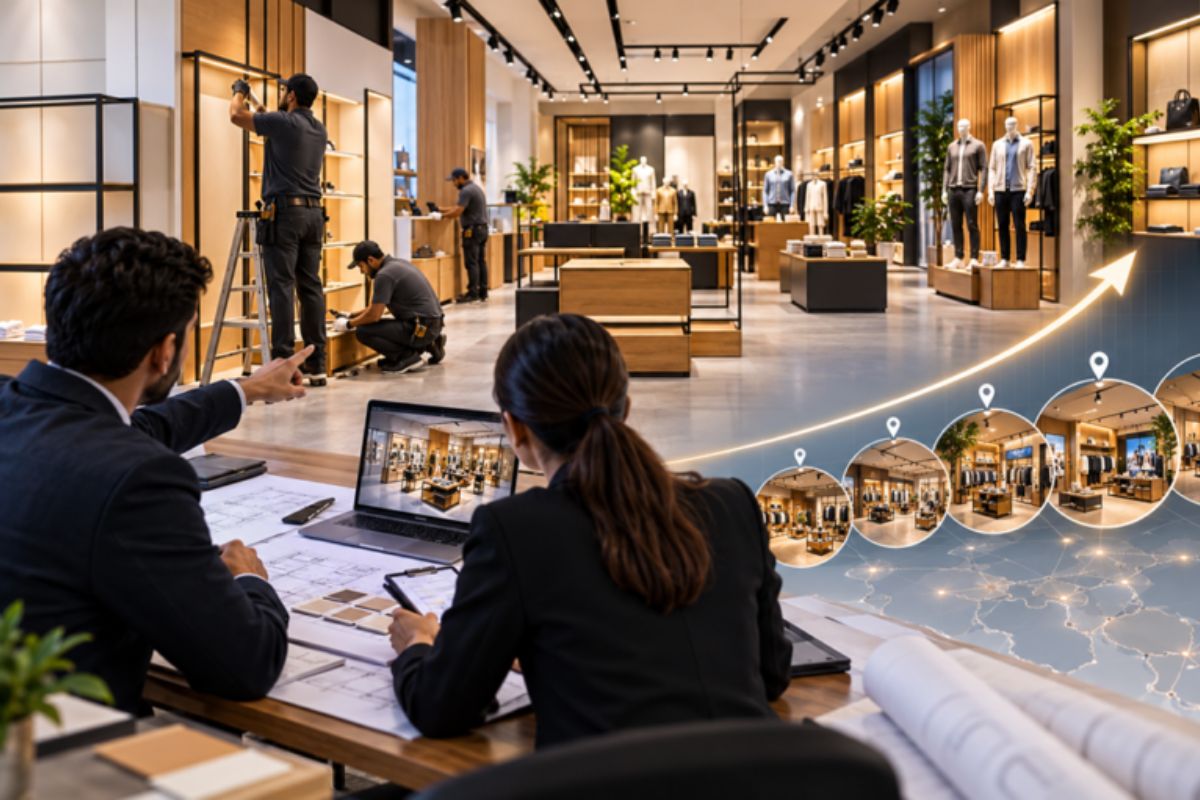
Retail can’t cope with agility change has been the tune sung for the past decade, retail agility was perceived as a “digital issue” until the aforementioned period. E-commerce platform needs of the customers, digitizing the supply chain, fine-tuning the real time inventory management system, and using sophisticated merchandising algorithms have dominated the market leadership industry brand goals almost exclusively. That was the digital-first narrative that now seems a little dated.
D’Art Private Limited , one of the leading retail design, manufacturing, and turnkey rollout providers in the world-has announced today a huge strategic initiative; that has taken them back to the physical space where they are and always were a global player. Storefront agility is not only about online systems but more importantly about the brands on the ground that seek to be quicker and smarter to implement storefronts before the narrow market opening window closes. The notion that success is only attainable to digitally competent market players is now a history.
The market leaders and losers have been diverging; the entire business reinvention goes far beyond a white elephant size project, but instead it’s an attitude that defines new leaders to be able to enter a physical store that is “time synchronized” with the digital campaign, being able to transform a brand concept for micro-markets (when region-specific), and implementing at once dozens of stores without having any operational disparity.
The Strategic Shift Nobody Framed Clearly Enough
For years, it wasn’t a retail technology that was considered underestimated, and where technology for the retail store deployment strategy sat. That was traditionally considered a subsequent stage of the project, the construction phase, an operational task that requires to be managed but fundamentally aimed at ensuring that a door can be physically opened on the day after the lease is signed. Strategy itself was what was considered to take place before-site selection, brand concept and brand positioning-and deployment, the actual delivery of the product.
McKinsey’s recognized the strategic paradigm shift, and in view of rapidly shorten trends cycles, fragmented local demand, broad Channelled consumers, behavior and uncertainty in the post-pandemic market place, brand’s physical presence delivery speed, have now become critical drivers of growth. It’s therefore not without reason that Deloitte’s 2025 Retail Industry Outlook highlighted the fact that operational agility and speed of delivery, are now at the forefront of retailers’ minds as not only as a capability for efficient operations but something to be invested in.
The Underlying Complexity of Modern Retail Store Execution
The increasing complexity of deploying a store in the modern retail era is a key reason for the above. Unlike previous decades, now, at the very least, multiple systems need to be integrated and running simultaneously where years ago it would have been a step-by-step process.
The ability to bring together all of the civil construction and fixtures, all elements of the build-and the digital capabilities, signage, integrated omnichannel systems, stock levels and operational readiness, new staff, all of the relevant regulations of the particular area and dozens of other details, within the deployment schedule, which has become more driven by the external than ever before-product drops, influencers, campaign delivery and the like, along with availability for the specific season; If one of these elements fails during deployment, it not only has implications for the store launch date, but for the campaign launch date, the availability of stock for the store, the successful synchronized delivery of the digital aspect, and for diluting brand momentum (although unquantifiable).
Regional launches are no longer ad-hoc and are now planned in cohesive regional plans for retailers of fashion and electronics, coordinated across closely integrated physical-ready, social-ready, digital-ready, and engagement driven events. If the supply does not match the need and scale, construction itself is just the start of the chain reaction.
Repeatability Is the Infrastructure of Retail Agility
For shoppers that do not appreciate the hot-potato experience, a belief system is actively and quietly practiced within sophisticated retail operational enterprises: Agility at scale equals standardization, not ad-hocism. This appears contrary as we typically associate standardization and rigidity with the opposition to agility and flexibility. Within the realm of physical retail, it is infrastructure and infrastructure delivery systems which enables scale and speed, both through and for this structure: This belief system of organizations such as McDonald’s and Starbucks is seen as positive, not necessarily in terms of size or brand scale but for its physical store deployment method.
It’s an example of adopting a modular strategy, highly repeatable processes (the “one-size-fits-all” ideology is defunct for store operations), and a coherent rollout to manage what might otherwise be a cumbersome scaling exercise. It is not that closure or sale preclude local adaptations, but enable local adaptation without forcing a reconstruction of the operating procedures from scratch. Across the fashion and electronics sectors, but also in lifestyle and specialty retail and the QSR world as well, scalability is seen by KPMG’s Global Retail Outlook, as “supported by infrastructure consistency and operational standardization.”
The Omnichannel Pressure on Physical Deployment
Again, physical store deployment and the performance of the omnichannel are two different things, the complexity of which isn’t always apparent in the definition of an omnichannel solution. Physical stores are not only the ‘sales’ interface but, due to the current market reality, are also the fulfillment nodes, pickup points, content providers, experience hubs and customer service center.
Over the last few years PwC’s Global Consumer Insights Survey relies on that principle for the expectation of seamless physical-digital shopping, to be satisfied at least at the time the store launches with this, leading to an opening day pressure that is not dissipated following day one of the store’s life.
Failure to provide that seamless experience in relation to new store deployments results in an underperforming store, not merely one less functionally capable; failure has critical implications, as click-and-collect, app integrated experiences and QR-linked physical retailing is no longer considered a Tier One differentiator. The ability ‘to deliver the connected retail space’ is still a fundamental challenge.
The Competitive Logic of Physical Speed
The discussions around the physical implementation element of the retail business will start to drive market survival, while corporate boardrooms might continue to focus on the discussion around data analytics, digital platforms and virtual supply chains. The retailers of the future who will be the undisputed winners in the next decade will be the ones who treat the deployment of a physical infrastructure as strategically important as the development of a digital infrastructure.
The key to the new competitive edge now lies in the exact speed and economic value of a new retail location being produced and put in place; the rapidity with which a brand experience can be replicated and localized to new competitive markets; and the simplicity with which an established network of stores can be re-branded, re-stocked and up-dated without provoking expensive business disruptions. Traditionally, store deployment was just the last step in the actualization of an abstracted brand idea.
Today this physical deployment model is the brand’s ultimate digital capability in terms of speed, precision and certainty. With strategic support from an integrated execution powerhouse such as D’Art Private Limited, progressive brands are creating a hyper-responsive physical infrastructure that can’t be matched or undermined by digital-only brands.

Leave a Reply
You must be logged in to post a comment.